

What Is an AI-Enabled School? A Complete Guide for School Leaders
Learn what an AI-enabled school is, how AI supports teachers and students, and how schools can build a connected, future-ready learning ecosystem.

Edubull Technology Team
Institutional Strategy & AI Pedagogy
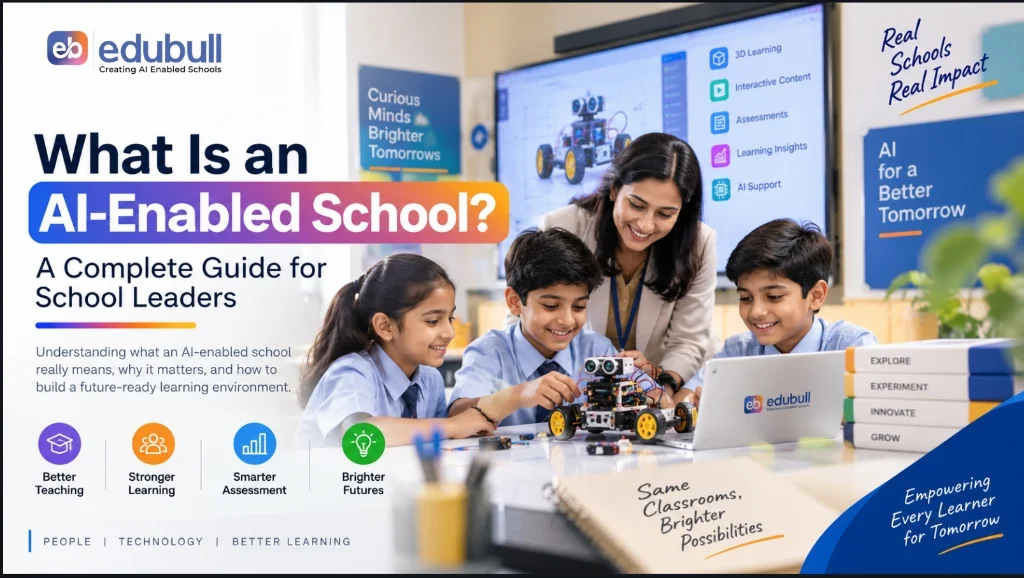
AI is becoming part of everyday life, and schools are beginning to ask a bigger question: what does it actually mean to become an AI-enabled school?
For many school leaders, the first thought is usually about technology—smart boards, AI tools, coding labs, or digital classrooms. But an AI-enabled school is not simply a school that has more technology.
It is a school where technology and intelligence are thoughtfully integrated into teaching, learning, assessment and school operations to help teachers teach better and students learn better.
“The real question is not “How much technology does the school have?” It is: “How effectively is technology improving learning?””
What Is an AI-Enabled School?
An AI-enabled school uses artificial intelligence, digital learning tools, data and connected classroom technologies to support the people who matter most in education—teachers, students and school leaders.
The purpose is not to replace teachers or turn classrooms into technology labs. Instead, AI can help teachers with everyday tasks, give students more personalised learning support, help identify learning gaps and give school leaders a clearer picture of what is happening academically.
Teach → Assess → Understand → Identify Gaps → Support → Reassess → Improve
This creates a continuous learning cycle rather than treating technology as something that is simply installed and forgotten.
Why Are Schools Looking at AI Now?
Schools have always used technology in some form. Computers, projectors, digital content and smart classrooms have already become familiar parts of modern education. AI takes this a step further.
Traditional digital tools generally provide access to content. AI can help make that experience more responsive and personalised.
For example, a teacher may have a class of 40 students. Every student may be studying the same chapter, but they may not have the same level of understanding:
- One student may need help with basic concepts.
- Another may be ready for advanced questions.
- Another may have understood the chapter but struggle during assessments.
This is where intelligent technology can become useful—not by replacing the teacher, but by helping the teacher understand these differences and respond to them.
What Does an AI-Enabled School Actually Look Like?
There is no single piece of technology that turns a school into an AI-enabled school. It is an ecosystem. A well-planned AI-enabled school can bring together several layers of technology:
1. AI-Enabled Academic Content
Learning can begin with the academic material itself. Books and curriculum can be connected with digital resources through AI Hybrid Textbooks such as 3D videos, interactive simulations, visual explanations and immersive learning experiences. This creates a seamless bridge between what students read and what they experience in the classroom.
2. Interactive Classrooms
An interactive classroom gives teachers more ways to explain concepts. With 3D Smart Classrooms and the AI Interactive Slate, a teacher can use rich visual content, interactive 3D demonstrations, and tactile engagement where they genuinely add value. The goal isn't to make every lesson flashy—the goal is to make difficult concepts intuitive and memorable.
3. AI-Assisted Teachers
Teachers spend a considerable amount of time preparing lessons, creating questions, checking student performance and planning remedial activities. With dedicated AI Co-Teacher tools, intelligent assistance helps with everyday tasks:
- Prepare lesson plans quickly and aligned to curriculum standards
- Create questions, quizzes, and formative assessments
- Find relevant teaching resources and visual aids
- Organise classroom activities and demonstrations
- Understand individual and class-wide student performance
- Identify areas where students need additional remedial support
This gives educators more time to focus on what technology cannot replace easily: mentoring, motivating, and connecting with their students.
4. Smarter Assessments & Diagnostic Analytics
An assessment should do more than produce a mark. A score tells you how a student performed. A good learning system powered by the ELIC Learning Intelligence Cycle helps answer: Why did the student perform that way?
AI and learning analytics help schools look beyond marks and identify patterns in student performance. For example, if a group of students repeatedly struggles with a particular concept, the teacher can revisit that concept instead of simply moving on to the next chapter.
5. Learning-Gap Identification
This is one of the most important opportunities for AI in schools. Students can move from one grade to another while carrying gaps from previous learning. If those gaps aren’t identified, they can become bigger over time.
“The objective is simple: Find the gap. Understand the gap. Work on the gap.”
6. Personalised Learning & Student Mentorship
Every classroom has students who learn at different speeds. Through Personalized Student Learning platforms and Emma AI Assistants, learners can access additional explanations, practice questions, revision material or remedial activities based on their unique learning pace. This doesn’t mean every student needs a completely different curriculum—it means the school can provide additional support whenever and wherever it is needed.
AI-Enabled School vs Smart School
These two terms are often used interchangeably, but there is an important difference:
- A smart school generally focuses on technology-enabled infrastructure—interactive panels, digital classrooms, digital content and connected systems.
- An AI-enabled school goes further by using data and artificial intelligence to make the learning ecosystem more responsive.
“Smart technology helps deliver learning. AI-enabled technology can help understand and improve learning.”
A school doesn’t necessarily need to choose one over the other. In fact, the strongest approach is often to combine the two.
What Role Does the Teacher Play?
This is perhaps the most important question school leaders should ask. Will AI replace teachers? The better question is: Can AI help teachers become more effective?
A teacher understands a child’s behaviour, confidence, curiosity, difficulties and personality in ways that technology cannot fully replicate. AI can provide information and assistance; the teacher provides context, judgement and human connection.
The future of AI in schools should not be AI versus Teachers. It should be: AI + Teachers.
What About Students?
For students, an AI-enabled school can create a more engaging and responsive learning environment. Students benefit from visual and interactive learning, digital resources, personalised practice, faster feedback, exposure to emerging technologies, and hands-on AI & Robotics Labs that foster problem-solving beyond the textbook.
But there is an important balance. Technology should support learning—not become the learning itself. A student who spends more time clicking through technology is not automatically learning better. The technology has to serve a clear academic purpose.
What Should School Leaders Consider Before Adopting AI?
Buying technology is relatively easy. Getting a school to use it effectively is much harder. Before adopting an AI solution, school leaders should ask 5 foundational questions:
Does it solve a real school problem? — Don’t adopt AI simply because everyone is talking about it. Identify the problem first: Is it teacher workload? Learning gaps? Assessment? Student engagement? Academic monitoring? Then look for the technology that can actually address it.
Will teachers actually use it? — A sophisticated platform has little value if teachers find it difficult to use. Teacher adoption should be considered from the beginning. The best technology is often the technology that fits naturally into a teacher’s existing workflow.
Is the system connected? — Schools often end up purchasing different products from different vendors (assessments, digital content, classroom management, robotics, analytics). This creates disconnected silos. Leaders should ensure technologies work together as part of a single ecosystem.
Is there a clear academic outcome? — Every technology investment should ultimately come back to learning. Ask: What will improve because we introduced this? If there is no clear answer, the technology may not be solving the right problem.
What happens after installation? — Installing a smart classroom is only the beginning. Teachers need training, students need guidance, leaders need visibility, and the system needs consistent daily usage.
How Can a School Start Its AI Journey?
A school doesn’t have to transform everything overnight. A practical 7-step roadmap can begin with key milestone areas:
Step 1 — Understand the school’s current academic and technology setup
Step 2 — Identify the biggest learning and teaching challenges
Step 3 — Introduce technology where it can create measurable value
Step 4 — Train teachers and build deep daily adoption
Step 5 — Connect teaching with assessment and learning data
Step 6 — Identify learning gaps and provide targeted support
Step 7 — Measure what is improving across grades and subjects
Where Does Edubull Fit In?
Edubull approaches the AI-enabled school as an integrated ecosystem rather than as a single isolated product. The idea is to connect academic learning with technology and intelligence across the entire institution.
This includes AI Hybrid Textbooks, 3D Smart Classrooms, digital and 3D learning content, the ELIC Learning Intelligence Cycle, automated assessments, learning-gap identification, AI Co-Teacher tools, and hands-on AI & Robotics Labs.
“Technology should not sit separately from education. It should become part of the learning journey.”
The Future of Schools Is Not Just Digital. It Is Intelligent.
The transition from traditional classrooms to digital classrooms was an important step. The next step is making those classrooms more intelligent.
An AI-enabled school is not defined by the number of screens on its walls or the number of AI tools it has purchased. It is defined by how effectively it uses technology to: help teachers teach, help students learn, help leaders understand, and help schools improve.
An AI-enabled school is not defined by the number of screens on its walls or tools purchased—it is defined by how effectively intelligence is integrated into teaching, assessment, gap identification, and continuous learning improvement.
Frequently Asked Questions
Q:What is an AI-enabled school?
An AI-enabled school integrates artificial intelligence, digital tools, learning data and technology into teaching, assessment and student support to improve the overall learning experience.
Q:Is an AI-enabled school the same as a smart school?
Not exactly. A smart school generally focuses on technology-enabled infrastructure, while an AI-enabled school uses intelligence and data to make teaching and learning more responsive.
Q:Can AI replace teachers in schools?
AI is better viewed as a support system for teachers. It can assist with repetitive tasks, planning, assessments and learning insights while teachers continue to provide human guidance, judgement and mentorship.
Q:How can AI help students?
AI can support personalised practice, digital learning, feedback, remedial learning and identification of areas where students need additional help.
Q:Is AI-enabled technology only for expensive schools?
Not necessarily. The important consideration is how the technology is implemented and whether it solves meaningful academic problems. Schools should evaluate solutions based on value, usability and outcomes rather than technology alone.
Q:How can a school start becoming AI-enabled?
Schools can begin by identifying their biggest teaching and learning challenges, selecting relevant technology, training teachers and gradually connecting teaching, assessment, learning data and intervention.
Ready to deploy turn-key 3D Smart Classrooms, AI-enabled Smart Textbooks, and the continuous ELIC Learning Intelligence Cycle?
