

How Edubull's AI-Enabled Books Connect Learning With Technology
Learn how AI-enabled books connect textbooks with digital content, 3D learning, assessments and AI-supported tools to create a connected learning experience.
Edubull Technology Team
Curriculum & Smart Textbook Systems
Introduction
For years, textbooks have been the foundation of classroom learning. They provide the syllabus, concepts, examples and exercises that students and teachers follow throughout the academic year.
But the way students learn has changed.
A textbook can explain a concept, but sometimes a student needs to see it, interact with it, watch an explanation, or practice it differently before the concept becomes clear.
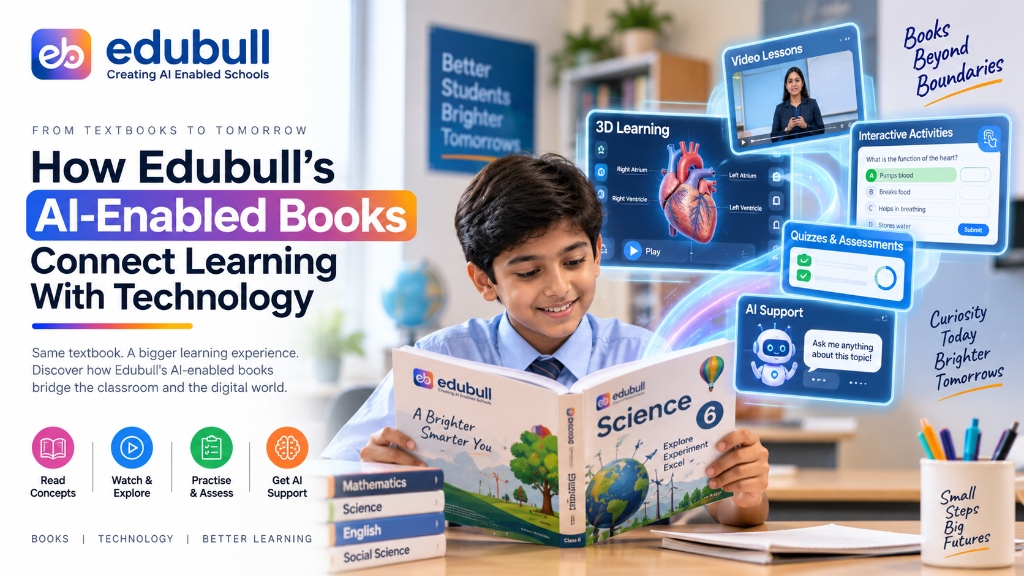
This is where AI-enabled books are becoming interesting. An AI-enabled book combines the familiar structure of a physical textbook with digital resources and technology that extend the learning experience beyond the printed page.
“Edubull's AI-enabled books are designed around this idea: the book remains the anchor of the learning process, while technology and intelligence add an interactive layer to it.”
What Is an AI-Enabled Book?
An AI-enabled book is essentially a physical or digital academic book that connects textbook content with technology-enabled learning resources.
Instead of treating the textbook and digital learning as two separate systems, the two can work together seamlessly.
For example, a lesson may begin with a concept in the AI Hybrid Textbooks and then lead the learner toward:
- A visual explanation with real-world context
- 3D learning content & interactive models in the 3D Smart Classroom
- Curated video lessons demonstrating experiments
- Interactive activities and simulations
- Quizzes and immediate comprehension checks
- Additional practice and remedial exercises
- Digital assessments connected to ELIC LMS learning insights
- AI-supported tutoring via AI Co-Teacher for concept explanations
The book provides the academic structure. Technology provides additional ways to understand, practise, and explore the concept.
Why Connect a Textbook With Technology?
One of the limitations of traditional textbooks is that they mainly provide information in a static format.
Consider a science chapter explaining the human heart. A diagram can show its structure. But a student may understand it better after seeing a progressive learning sequence:
Diagram in the printed textbook as the reference point
3D interactive model to rotate, isolate, and inspect heart chambers
Animation of blood flow, valve mechanics, and cardiac cycles
Teacher/Voice explanation breaking down intricate medical concepts
Instant quiz assessing student comprehension on the spot
The objective isn't to replace the textbook. It is to give students more than one way to understand the same concept. This is particularly useful for concepts that are:
- Difficult to visualise through 2D illustrations alone
- Process-based and dynamic in nature
- Highly conceptual (such as physics laws, chemical reactions, or robotics in Robotics Labs)
- Dependent on live demonstrations or laboratory experiments
- Difficult to explain using text alone
How Does the Book-to-Digital Connection Work?
The basic idea can be understood as a simple, interconnected learning journey:
Read → Explore → Understand → Practise → Assess
A student first encounters the concept through the academic book. Technology then provides curated digital resources directly mapped to that exact topic.
| Stage | Learning Experience |
|---|---|
| Read | Student studies the concept in the textbook or digital flipbook |
| Explore | Student accesses related digital content via smart QR codes or the digital portal |
| Understand | Student uses videos, visuals or 3D Smart Classroom resources for deeper clarity |
| Practise | Student attempts interactive activities, simulations or practice questions |
| Assess | Student completes a digital quiz or structured assessment for instant feedback on ELIC LMS |
This creates a connected learning experience instead of keeping physical and digital learning completely separate.
What Can Be Connected to an AI-Enabled Book?
The exact resources can vary depending on the subject, grade, and learning system. Common examples include:
1. Videos
Some concepts are easier to understand when students can watch a demonstration or explanation. For example: science experiments, mathematical concepts, historical events, language activities, and geography concepts. Video provides visual context that text alone cannot.
2. 3D Learning
3D content is particularly valuable for subjects where students need to understand spatial structures or internal mechanics—such as human organs, the solar system, geographical landforms, complex machines, and molecular structures. In the 3D Smart Classroom, students explore interactively in full 3D instead of staring at flat pages.
3. Interactive Content
Interactive activities turn passive reading into active participation. Students can manipulate variables, answer checkpoints, interact with visual elements, and receive immediate explanatory feedback.
4. Quizzes and Assessments
The learning journey does not end when the student finishes reading a chapter. Digital quizzes connected to the chapter evaluate whether the student actually understood the concept, providing actionable practice before term examinations.
5. AI-Supported Learning
AI adds an intelligent layer to support activities such as answering student questions, providing alternative step-by-step explanations via AI Co-Teacher, generating dynamic practice questions, supporting targeted revision, and identifying learning gaps where extra practice is required.
“The purpose is not to make the textbook “smart” simply by adding AI for the sake of novelty. The real objective is to use AI where it measurably improves the learning process.”
What Does This Look Like in a Classroom?
Imagine a teacher teaching a chapter about the solar system:
With a traditional textbook: Teacher explanation → textbook diagram → exercise questions.
With connected technology: Textbook concept → visual/3D interactive exploration on the AI Slate smart panel → teacher explanation & class discussion → student activity → instant quiz.
The teacher still leads the lesson. The textbook still provides the academic structure. Technology simply gives the teacher and students additional learning tools.
How Can Teachers Use AI-Enabled Books?
For teachers, the value of connected learning is not limited to student engagement. A well-designed system helps teachers access resources mapped directly around the curriculum without wasting hours searching across disconnected websites.
- Ready-to-use teaching resources and lesson plans on ELIC LMS
- 3D visual explanations and laboratory simulations in 3D Smart Classrooms
- In-class activities and interactive discussion prompts
- Curated question banks and automated grading with AI Co-Teacher
- Targeted revision material and learning-gap diagnostics
AI-Enabled Books vs Traditional Textbooks
The difference is not that one is “better” simply because it uses technology. The difference is in how the learning experience is structured:
| Traditional Textbook | AI-Enabled Book |
|---|---|
| Primarily static content | Content connected with dynamic digital & 3D resources |
| Text and 2D images only | Text, images, video, 3D models and interactive simulations |
| Separate digital platforms required | Digital resources connected directly to textbook chapters |
| Practice mainly through printed exercises | Combines printed exercises with interactive digital practice & assessments |
| Limited personalization | Supports AI-assisted adaptive learning via AI Co-Teacher |
| Learning largely stays within the book | Learning extends into a connected Edubull Ecosystem |
“An AI-enabled book doesn't make the textbook irrelevant. It makes the textbook a gateway to a broader learning environment.”
Does AI-Enabled Mean the Teacher Becomes Less Important?
No. Technology provides resources, automation, and learning support, but the teacher continues to play the most crucial role in education.
A teacher understands things that technology cannot replace: classroom dynamics, student behaviour, individual context, motivation, communication, emotional support, and how to adapt an explanation for a particular group of learners.
Teacher + Textbook + Technology + AI (rather than Teacher vs AI)
How Can Students Benefit?
- More ways to understand — A student who struggles with written text can gain clarity through a 3D model, video, or step-by-step interactive simulation.
- More opportunities to practise — Digital quizzes and interactive activities provide continuous practice beyond standard printed exercises.
- Learning beyond classroom hours — Connected digital resources empower students to revisit difficult concepts anytime from home.
- Personalised support — AI-powered tutoring with AI Co-Teacher can provide on-demand explanations and tailored revision based on individual weaknesses.
What Should Schools Look for in an AI-Enabled Book?
Curriculum Alignment — Are the digital resources mapped directly to the school’s academic syllabus and textbooks?
Teacher Usability — Can teachers effortlessly integrate the resources into regular daily teaching without friction?
Student Experience — Is the technology genuinely improving conceptual comprehension and retention?
Content Quality — Are the videos, 3D simulations, and assessments academically sound and pedagogically verified?
Assessment & Diagnostics — Does the system provide clear visibility into student understanding on ELIC LMS?
Accessibility — Can students and teachers access resources smoothly across AI Slate panels, tablets, and phones?
Ecosystem Integration — Do the books, classroom tools, assessments, and analytics work together as one cohesive platform?
Where Does Edubull Fit In?
Edubull's AI-enabled books are designed as part of a comprehensive learning ecosystem. The textbook provides the academic foundation, while connected technology extends the experience through 3D Smart Classrooms, AI Slate Interactive Panels, digital flipbooks, interactive practice, ELIC Learning Intelligence, and AI Co-Teacher tools.
Books → Classroom → Digital Content → Assessment → Learning Insights
The Bigger Idea: From Textbook to Learning Interface
The role of the textbook is expanding rapidly from a static source of information into a dynamic starting point for connected learning.
Traditionally: Textbook = Source of Information
With Connected Learning: Textbook = Starting Point for Learning
With AI-Enabled Education: Textbook + Technology + Data + AI = Connected Learning Experience
“Does it help students understand better, help teachers teach more effectively, and give schools better visibility into learning? That is the standard against which AI-enabled learning technology should ultimately be evaluated.”
An AI-enabled book doesn't make the textbook irrelevant—it makes the textbook a gateway to a broader, connected learning environment where books, classrooms, digital content, and AI intelligence work together.
Frequently Asked Questions
Q:What is an AI-enabled book?
An AI-enabled book connects academic textbook content with digital, interactive, 3D, and AI-supported learning resources to provide students and teachers with multiple modalities of learning.
Q:Is an AI-enabled book the same as a digital textbook?
Not necessarily. A digital textbook primarily converts the book into a digital PDF or e-reader format. An AI-enabled book connects academic content with interactive simulations, 3D visualizations, automated assessments, and AI-supported learning assistance.
Q:Can AI-enabled books replace teachers?
No. They are designed to provide additional learning and teaching support. Teachers remain central to classroom learning, pedagogy, and student mentorship.
Q:What subjects can use AI-enabled books?
AI-enabled learning applies across Science, Mathematics, Social Studies, English, Computer Science, Environmental Studies, and Hindi, bringing abstract concepts to life.
Q:Do students still need physical textbooks?
Yes. Connected learning does not eliminate physical books; it combines physical academic textbooks with seamless digital layers, giving students the benefits of both worlds.
Ready to deploy turn-key 3D Smart Classrooms, AI-enabled Smart Textbooks, and the continuous ELIC Learning Intelligence Cycle?
